Imagine walking into an office where AI assistants manage schedules, blockchain secures every transaction, and virtual reality powers collaboration across continents. This isn’t science fiction—it’s the direction modern work and business are heading. Emerging technologies are evolving at a rapid pace, and those who adapt early gain a massive advantage.
The Future Is Already Here
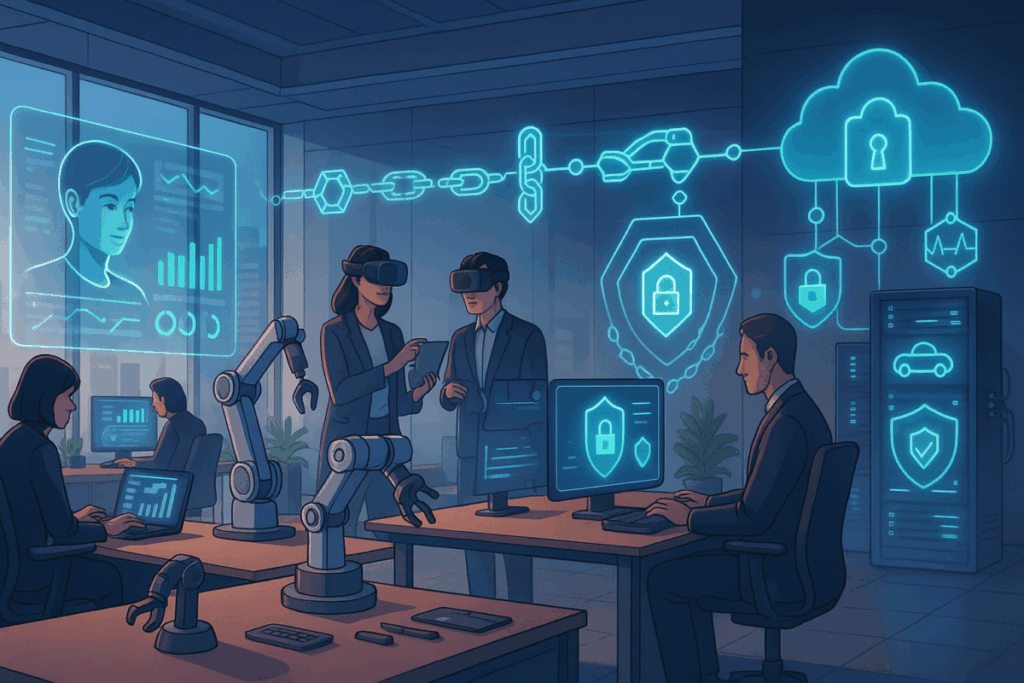
But which innovations will truly define the next decade? Let’s dive into 5 powerful emerging technologies shaping the way we work and do business.
1. Artificial Intelligence and Machine Learning
Transforming Everyday Work
AI is no longer just a buzzword—it’s a tool that businesses of all sizes are using to save time and increase efficiency. From chatbots handling customer queries to AI-driven analytics predicting market trends, machine learning is transforming decision-making.
Real-World Example
Companies like Netflix use AI to recommend shows based on viewing patterns, while in the business world, financial institutions rely on machine learning algorithms to detect fraud in real-time.
Data to Consider
According to PwC, AI could contribute up to $15.7 trillion to the global economy by 2030, making it one of the most impactful technologies of our era.
2. Automation and Robotics
Beyond Manufacturing
While automation has long been associated with assembly lines, it now extends into offices, logistics, and even creative industries. Software robots (RPA—Robotic Process Automation) are automating repetitive tasks like invoice processing, data entry, and compliance reporting.
Storytelling Moment
Picture a small business owner who used to spend hours every week reconciling spreadsheets. With RPA tools, those tasks now run automatically, freeing up time for strategic planning and customer engagement.
The Bigger Picture
McKinsey estimates that automation could raise global productivity growth by 0.8 to 1.4% annually—a massive boost for businesses adapting to it early.
3. Blockchain Technology
More Than Just Cryptocurrency
While blockchain often brings Bitcoin to mind, its applications for business are much broader. At its core, blockchain is about trust, transparency, and security.
Use Cases in Business
- Supply chain management: Companies can track products from origin to customer with complete transparency.
- Smart contracts: Automated agreements that execute when conditions are met, reducing legal costs.
- Data security: Businesses can store sensitive information in tamper-proof digital ledgers.
Example
Walmart uses blockchain to track food products, reducing the time to trace contaminated goods from seven days to just 2.2 seconds—a game changer for safety and efficiency.
4. Extended Reality (VR, AR, and MR)
Redefining Collaboration
Extended Reality (XR) brings immersive digital experiences into the workplace. Virtual Reality (VR) can host virtual meetings, Augmented Reality (AR) helps workers repair machinery with step-by-step overlays, and Mixed Reality (MR) combines both for interactive collaboration.
Storytelling Example
Imagine architects in different countries putting on VR headsets and walking through the same 3D model of a building. Instead of sending endless revisions over email, they interact in real-time as if standing side by side.
Data Insight
A report from Statista predicts the XR market will reach $52 billion by 2027, proving it’s more than just a passing trend.
5. Cloud Computing and Edge Technology
Powering Flexible Work
The rise of remote work has shown how crucial cloud computing has become. From Google Workspace to AWS, businesses rely on the cloud to collaborate, scale, and store data securely.
What’s New: Edge Computing
Edge computing takes things further by processing data closer to its source, reducing latency. For industries like autonomous vehicles or healthcare devices, real-time data is critical.
Example
Think of a hospital using edge-enabled devices to monitor patient vitals in real-time, sending alerts instantly if something is wrong—life-saving speed made possible by this technology.
Conclusion: Preparing for the Future of Work
The future of work and business will not be defined by a single technology but by how these emerging innovations converge. AI enhances decision-making, automation frees up human creativity, blockchain secures trust, XR redefines collaboration, and cloud-edge systems make work faster and more flexible.
Call-to-Action:
If you’re a business leader or professional, the question isn’t whether to adopt these technologies—it’s how soon you’ll integrate them into your strategy. Start small, experiment, and embrace the change. The future isn’t waiting, and neither should you.

Penulis di Ascendory yang fokus membantu pembaca naik level lewat teknologi,
pengembangan diri, dan strategi bisnis online yang praktis. Suka eksplorasi tools
produktivitas, tren digital, dan cara menyeimbangkan hidup biar tetap waras meski
sibuk. Percaya bahwa kemajuan kecil yang konsisten lebih ampuh dari semangat
sehari yang langsung padam.