In 2025, AI is no longer just about automating repetitive tasks. It’s about empowering businesses with autonomous systems that think, learn, and act.
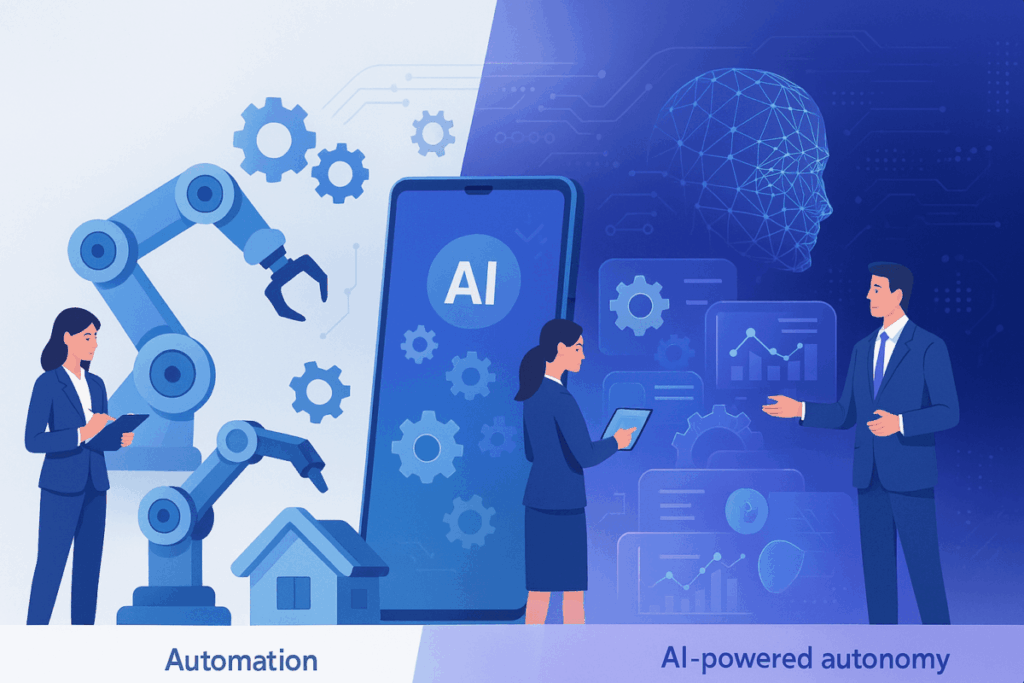
What began as rule-based automation tools has evolved into intelligent platforms capable of making complex decisions with minimal human intervention. Today, AI is redefining how businesses operate, deliver value, and compete. This article explores how AI has moved beyond traditional automation to reshape business models across industries.
From Automation to Autonomy: What’s the Difference?
Automation refers to the use of technology to execute predefined tasks based on specific rules. Think of it as a digital assistant following strict instructions.
Autonomy, on the other hand, leverages AI to perform decision-making based on real-time data, context, and learned behavior. It can analyze, predict, and adapt without constant oversight.
Key enablers include:
- Machine Learning (ML): Algorithms that improve with experience
- Natural Language Processing (NLP): Understanding and generating human language
- Real-time Analytics: Continuous data monitoring for immediate insights
This shift allows companies to go from “doing things faster” to “doing things smarter and independently.”
How AI Is Reshaping Business Models in 2025
1. Dynamic Pricing & Smart Sales Models
Retail and e-commerce sectors are leveraging AI to implement dynamic pricing strategies. AI analyzes competitor pricing, customer behavior, and market demand in real time.
- AI adjusts prices automatically during flash sales, product launches, or demand surges
- Subscription platforms modify pricing tiers or feature sets autonomously to match user patterns
2. AI-Powered Customer Experience
Customer service is being redefined by conversational AI and advanced analytics:
- Virtual agents understand tone, emotion, and intent
- AI chatbots provide consistent, round-the-clock support
- Hyper-personalized product recommendations enhance engagement
The result? Reduced human workload and increased customer satisfaction.
3. Supply Chain Autonomy
Supply chains have become intelligent, predictive, and responsive:
- AI forecasts demand spikes using historical and real-time data
- Autonomous systems reroute shipments to avoid delays
- Inventory management systems reorder stock before it runs out
These capabilities significantly lower costs and increase efficiency.
4. Autonomous Financial Decision-Making
In 2025, CFOs rely on AI to simulate economic scenarios and manage risks:
- AI systems generate multi-variable financial forecasts
- Fraud detection tools flag anomalies within seconds
- Consumer fintech apps help users manage budgets proactively
Financial autonomy supports better, faster strategic decisions.
5. Talent & HR Reimagined
AI has transformed human resource management:
- Algorithms screen resumes and shortlist candidates with higher precision
- Predictive analytics flag potential employee churn early
- Personalized learning paths help employees reskill in real time
The HR department is no longer reactive—it’s data-driven and future-ready.
Real-World Examples
- Amazon: Uses AI for dynamic warehousing and autonomous delivery experiments
- Tesla: Innovates with autonomous driving and AI-powered factory operations
- Alibaba: Leverages AI for logistics, pricing, and customer service at scale
Small Business Use Case: A startup in Indonesia uses Zoho CRM with AI insights to automate lead scoring, follow-ups, and email personalization—boosting sales conversion by 35%.
Challenges in Moving Toward Full Autonomy
While promising, the shift to AI autonomy comes with hurdles:
- Ethical and Privacy Concerns: Ensuring AI decisions are fair, unbiased, and explainable
- Resistance to Change: Traditional workflows often clash with autonomous processes
- Integration Complexity: High upfront costs and system compatibility issues remain barriers
Overcoming these requires a strong change management strategy and investment in infrastructure.
What This Means for the Future of Work & Strategy
Businesses must rethink their entire operating model:
- Roles will evolve from execution to oversight and strategic input
- Leaders must become AI-literate and champion data-driven decision-making
- Human intuition and ethics will remain essential in guiding autonomous systems
The smartest companies won’t just use AI as a tool—they’ll treat it as a co-strategist.
Conclusion & Takeaway
AI is no longer just executing—it’s deciding, predicting, and transforming. As we shift from automation to autonomy, businesses that embrace AI-driven thinking will lead in innovation, efficiency, and customer impact.
Now is the time for businesses to evolve from automation to autonomy—starting with the right AI strategy.

Penulis di Ascendory yang fokus membantu pembaca naik level lewat teknologi,
pengembangan diri, dan strategi bisnis online yang praktis. Suka eksplorasi tools
produktivitas, tren digital, dan cara menyeimbangkan hidup biar tetap waras meski
sibuk. Percaya bahwa kemajuan kecil yang konsisten lebih ampuh dari semangat
sehari yang langsung padam.